



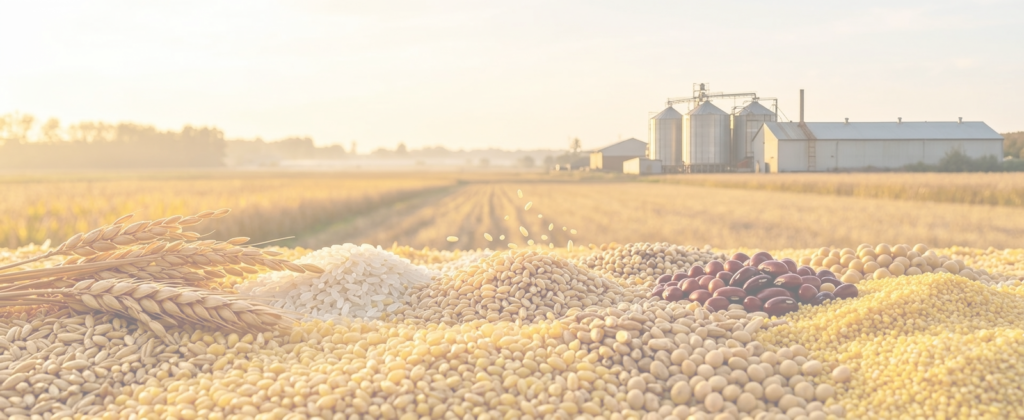
The 80T/D Industrial Rice Milling Machine is a large-scale, fully automatic rice processing solution designed for commercial rice mills, grain processing enterprises, and industrial-scale rice production facilities. With a daily processing capacity of 80 tons of paddy rice, this integrated production line delivers continuous, high-throughput milling with minimal human intervention. The entire system—from raw paddy intake to finished rice packaging—is controlled through an automated PLC system, significantly reducing labor requirements while maintaining consistent product quality across all shifts. This industrial-grade solution is purpose-built for processors who demand high output volume, operational reliability, and cost efficiency in their rice milling operations.
Working Principle
The 80T/D system operates through a fully automated sequential process. Raw paddy rice passes through each stage continuously, with sensors and automation controls regulating material flow, machine parameters, and quality feedback throughout the line. The complete workflow is as follows:
Raw Paddy Intake & Pre-Cleaning → Vibrating Cleaner & De-stoner → Rubber-Roll Husker → Paddy Separator → Vertical Multi-Pass Whitener → Mist Polisher → Gravity Grader & Length Grader → Automatic Weighing & Packaging
1. (Vibrating Cleaner & De-stoner)
This is the first-stage impurity removal unit. The vibrating cleaner uses a multi-layer sieve to remove large impurities—straw, husk clumps, dust, and light debris—while the suction fan extracts lightweight contaminants. The de-stoner then removes heavy impurities such as stones, glass, and metal particles using a fluidized bed with controlled air flow. Clean paddy entering the milling stage directly improves downstream equipment performance and extends wear-part service life.
2. (Rubber-Roll Husker)
The husker is equipped with a pair of high-durability rubber rollers rotating at differential speeds (typically 1.2:1 to 1.5:1 speed ratio). Paddy grains passing through the roller gap experience shear force that splits and removes the husk while leaving the brown rice kernel intact. An automatic gap adjustment mechanism responds to feed rate variations in real time, maintaining a consistent husking rate of 88–93% under normal operation. The separated husk is discharged via suction ducting and collected for use as animal bedding, fuel, or biomass material.
3. (Paddy Separator)
The paddy separator receives the husker discharge mixture containing brown rice, unhulled paddy, and residual husk fragments. Using a gravity separation deck with oscillating motion, the machine stratifies materials by density: heavier brown rice moves upward and exits as the finished product stream, while lighter unhulled paddy descends and is recirculated back to the husker via a closed-loop return conveyor. This self-circulating system ensures that only fully husked rice progresses to the whitening stage, maximizing the yield of intact kernels.
4. (Vertical Multi-Pass Whitener)
The whitening section is the heart of the 80T/D line, configured with multiple vertical whitening chambers arranged in series. Each chamber uses abrasive sand rollers and iron rollers in a progressive sequence: the initial chambers remove the outer bran layer, middle chambers achieve intermediate whitening, and final chambers produce the desired degree of whiteness. The vertical arrangement allows gravity-assisted material flow between chambers, reducing mechanical conveying damage. A negative-pressure air system extracts bran powder in real time, keeping the rice surface clean and minimizing kernel temperature rise.
5. (Mist Polisher)
The mist polisher applies a fine water mist (at a controlled rate of 0.3–0.5% of rice weight) to the milled rice surface during gentle polishing. The moisture softens residual bran particles and creates a polishing effect as kernels rub against each other, resulting in a bright, glossy surface finish comparable to premium commercial rice. The polishing intensity is adjustable via water flow rate and polishing time settings, allowing operators to tailor the final appearance for different market tiers.
6. (Gravity Grader, Length Grader & Color Sorter)
This quality-control section consists of three stages:
- Gravity Grader: Separates whole kernels from broken rice by specific gravity difference. Typically yields three fractions—head rice, large brokens, and small brokens.
- Length Grader: Rotating cylinder with precisely sized indentations that further separates brokens by length, achieving fine-grade classification for premium packaging.
- Color Sorter (optional but recommended): High-resolution optical sensors detect and eject discolored kernels, chalky grains, and foreign materials using precision air jets, ensuring the final product meets the strictest visual quality standards.
7. (Automatic Weighing & Packaging)
The final station is a fully integrated weighing and packaging unit. Finished rice is fed into a multi-head weighing hopper that achieves ±2 gram accuracy per bag, then discharged into bagging chutes. Options include polypropylene bag sealing, vacuum packaging, or bulk discharge — all managed through the central PLC with user-defined bag weight and packaging speed settings. The system can handle 5 kg, 10 kg, 25 kg, and 50 kg bag sizes with tool-less changeover.
Features
1. Fully Automated PLC Control System
The entire production line is governed by a central programmable logic controller that monitors and adjusts machine parameters—including feed rate, roller gap, whitening pressure, and air suction—across all processing stages. Sensors at each transfer point provide real-time feedback on material flow and machine status, enabling the system to self-correct without operator intervention. A touch-screen HMI (Human-Machine Interface) provides intuitive monitoring and parameter adjustment through a single control panel.
2. Multi-Stage Vertical Whitening Technology
The whitening section features multiple vertical whitening chambers arranged in series. Each chamber progressively removes the bran layer: initial chambers use coarse abrasive rollers for outer bran removal, middle chambers use fine abrasive rollers for intermediate whitening, and final chambers use iron rollers for precision finishing. The vertical orientation allows gravity-assisted grain flow between chambers, reducing mechanical conveying damage and minimizing kernel breakage.
3. Industrial-Grade Rubber-Roll Husker with Auto Gap Adjustment
The husker is equipped with large-diameter rubber rollers driven by independent motors at a precisely controlled differential speed ratio. An automatic gap adjustment system continuously senses feed volume and roller wear, maintaining optimal husking clearance in real time. This feature ensures consistent husking rates of 88–93% throughout the production run, even as roller surfaces gradually wear during extended operation.
4. Integrated Multi-Stage Quality Sorting
The downstream section combines gravity grading, length grading, and optical color sorting into a unified quality-control module. The gravity grader separates whole kernels from brokens by density; the length grader further classifies brokens into precise size fractions; and the color sorter uses high-resolution cameras and air-jet ejection to remove discolored, chalky, or foreign grains. This three-stage sorting ensures the final product meets the most stringent commercial rice quality standards.
Advantages
1. Significant Labor Cost Reduction
The fully automated design enables a single operator to monitor the entire 80-ton daily production line from the central control room. Compared to conventional semi-automatic rice mills requiring 8–12 operators per shift, the 80T/D line reduces direct labor to 2–3 operators per shift—a labor savings of 60–75%. Over a three-shift operation, this translates to annual labor cost savings of $80,000–$120,000 depending on local wage rates.
2. High Head Rice Yield at Industrial Scale
The combination of gentle husking, vertical multi-pass whitening, and reduced mechanical conveying achieves head rice yields of 58–65% (depending on raw paddy quality) at the 80-ton daily capacity level. This is comparable to much smaller, gentler milling systems, demonstrating that the line’s industrial throughput does not come at the cost of kernel integrity. Each additional percentage point of head rice yield at this scale translates to approximately 800 kg more whole-grain rice per day, representing significant revenue upside.
3. Consistent Product Quality Across Long Production Runs
The PLC automation eliminates the variability introduced by human operators—machine parameters remain stable regardless of shift changes, operator fatigue, or skill differences. This consistency means that a customer purchasing milled rice in the morning and evening receives the same whiteness, polish level, and broken content. For processors supplying supermarket chains and institutional buyers with strict quality specifications, this consistency is a critical competitive advantage.
4. High Throughput with Low Per-Ton Operating Cost
Total power consumption across the complete line is optimized to 22–26 kWh per ton of finished rice, achieved through energy-efficient motors, matched drive systems, and automated load-based power management. Combined with the reduced labor cost, the total per-ton processing cost is typically 20–30% lower than semi-automatic mills of comparable capacity, directly improving the processor’s margin on every ton of rice produced.
Benefits
1. Rapid Scalability for Growing Demand
With 80 tons of daily processing capacity, the system can handle paddy from approximately 2,000–2,500 acres of rice fields per harvest season (depending on regional yield). This throughput allows processors to take on larger contracts, serve multiple supply channels simultaneously, and capture market share from smaller competitors. As rice consumption continues to grow in both domestic and export markets, this capacity positions the processor for long-term revenue growth.
2. Lower Capital Cost Per Ton of Capacity
When measured on a cost-per-ton-of-daily-capacity basis, the 80T/D fully automatic line offers 15–25% lower capital investment compared to installing multiple smaller-capacity mills to achieve the same total throughput. A single line also requires less floor space, simpler foundations, and fewer auxiliary systems (dust collection, electrical infrastructure) than multiple smaller units—reducing the total project investment and installation timeline.
3. Premium Product Positioning for Higher Margins
The combination of multi-pass whitening, mist polishing, and three-stage quality sorting enables the production of rice that meets premium market specifications—low brokens, high polish, uniform grain size, and zero discolored kernels. This quality level commands 15–25% price premium over standard milled rice in wholesale markets, directly increasing the processor’s margin per ton. For export-oriented mills, meeting international grade standards opens access to higher-margin overseas markets.
4. Enhanced Operational Safety and Reduced Downtime
Automation removes the need for operators to work near moving machinery—all monitoring and adjustments are performed from the control room. The PLC system includes automatic shutdown triggers for over-temperature, over-current, and material blockage conditions, protecting both equipment and personnel. Historical data from similar installations shows that fully automated lines achieve operating uptimes of 92–96% versus 80–85% for manually operated mills, meaning more tons processed per month with fewer disruptions.
Conclusion
The 80T/D Industrial Rice Milling Machine Fully Automatic delivers industrial-scale processing capacity with integrated automation that dramatically reduces labor dependency and operational complexity. Each stage of the workflow—from cleaning and husking to whitening, polishing, and packaging—is engineered around the physical characteristics of rice: its grain structure fragility, bran adhesion properties, and market quality requirements. For rice processors looking to scale up production capacity, improve product consistency, and reduce per-ton labor costs, this fully automatic line offers a complete, turnkey solution.
Interested in the specific configuration and workshop layout for an 80T/D industrial rice milling machine, or a processing workflow customized to your specific rice varieties? Please leave a message below, and our industrial projects team will provide a detailed equipment quotation and technical proposal within 24 hours.